

LEV MÉS · Materials
Topaz
Topaz combines natural colour variation with a history of deliberate colour change. Locality studies and surviving cut stones reveal very different sides of the same mineral. 1 2 3

Reading the formula
Al₂SiO₄(F,OH)₂ 5
Topaz 5
Al stands for aluminium and Si for silicon. F denotes fluorine and OH a hydroxyl group. The brackets indicate possible substitution; colour cannot be read from this formula alone. 5
Material classification is not an analysis of an item of jewellery offered for sale.
When orange becomes pink
Topazes from the Capão area were the subject of field and heating investigations published by Sauer, Keller and McClure in 1996. Some brownish-yellow or orange samples became pink. A stronger short-wave UV response after heating appeared to be a possible clue, but the small sample kept that observation explicitly preliminary. An attractive colour does not reveal an entire treatment history. 2
Documented country examples
Topazes from Mason County, Texas, were described as colourless, blue and yellowish-brown pieces. Some had stronger blue zones. Natural colour variation at an investigated locality does not establish where another blue topaz comes from or whether its colour has been treated. 1
Country areas provide orientation. Records may concern occurrences, examined specimens or collection objects; each country states its role. No mine locations or confirmation of the origin of our jewellery.
An accidental rediscovery
A birthstone for November
In its current birthstone calendar, GIA assigns topaz to November alongside citrine. The range of colours allows different jewellery designs for the same birth month. 6
What this source establishes
The month association describes GIA’s current birthstone calendar.
Wearing and care
Everyday care
Even with a Mohs hardness of 8, topaz can break along its cleavage direction. GIA recommends warm soapy water rather than ultrasound or steam. Coated surfaces should not be treated with abrasives. 7
The complete piece
This recommendation concerns the named material. Jewellery also requires consideration of its setting, coating, string and other components.
From material to jewellery
Topaz in jewellery
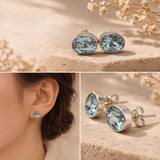
Selected by the material name used in the shop. This link does not identify an individual stone or confirm its treatment or origin.
Sources and locators
The numbers lead to the source records. Open an entry for the original source, its role and the relevant passage.
1 Documented country examples · Original research
2 Treatment and manufacture · Original research
An Update on Imperial Topaz from the Capão Mine, Minas Gerais, Brazil (opens in a new tab)
3 A closer look · Collection record
Topaz: American Golden Topaz, NMNH G9875 (opens in a new tab)
4 A closer look · Original research
5 The material’s history · Original research
6 Tradition and meaning · Current institutional classification
7 Wearing and care · GIA care guidance
Additional references and detail
An exceptional cutting project
Leon Agee spent two years in the late 1980s faceting a large rounded piece of rough into the Smithsonian’s American Golden Topaz. 3
A treated green changes in light
In the 1993 investigation of reactor-irradiated Ocean-green topazes, direct sunlight changed the tested green samples to blue within a day. One sample tested under indoor lighting remained green for 48 hours. These are results for particular treated samples under those conditions, rather than a rule for every green topaz. 4
Limits of this information
The examples concern the specimens, objects and sources named. They do not establish the origin, treatment or health effects of a specific item of jewellery.