

LEV MÉS · Materials
Peridot / olivine
Peridot is gem-quality green olivine. Its locality stories lead from basalt in Arizona to examined rock samples from Vietnam. 1 2

- Formula
- (Mg,Fe)₂SiO₄ 8
Reading the formula
(Mg,Fe)₂SiO₄ 8
Mg stands for magnesium and Fe for iron. The brackets show that both can occupy corresponding positions. Their ratio depends on the olivine examined. 8 9 10
Three peridot-bearing nodules provided the starting material for the 2016 Vietnam study. The chemically investigated samples had a forsterite component of 90.6–91.3 mole percent, consistent with magnesium-rich olivine. Internal features included dark chromite crystals and disc-shaped structures around inclusions. These observations concern that particular material series. 1
Material classification is not an analysis of an item of jewellery offered for sale.
Documented country examples
Nodules in San Carlos basalt
At Peridot Mesa, Arizona, Koivula found peridot in nodules within basalt. For his 1981 report, he visited and sampled the locality with permission from the San Carlos Apache Tribal Council. 3
Peridot from Myanmar
Peridots from Pyaung-Gaung in the Mogok area were also investigated. Samples came partly from miners and partly through trade. Round to oval stress features, often called lily pads, surrounded some inclusions. These features are informative, but not sufficient alone to establish origin, since similar ones occur in other material. 2
Country areas provide orientation. Records may concern occurrences, examined specimens or collection objects; each country states its role. No mine locations or confirmation of the origin of our jewellery.
The material’s history
Medusa on a Roman ring stone
A ring stone in the Metropolitan Museum depicts the head of a sleeping Medusa. The museum identifies peridot and dates Roman object 81.6.120 approximately between the first century BC and the third century AD. The engraved stone records historical jewellery use. What the motif meant to a former owner remains unresolved. 4
A pendant combining several materials
A French pendant from the late nineteenth century in Tokyo’s Kaji Collection combines peridot with enamel, gold, diamond and pearl. Its material list makes clear that a jewel involves more than one stone. Care must therefore take its setting and other components into account. The historical objects do not establish a health effect of the material. 5
A green stone for August
In GIA’s current birthstone calendar, peridot is assigned to August. This association links the green stone with a personal date. 6
What this source establishes
The month association describes GIA’s current birthstone calendar.
Wearing and care
Everyday care
Protect peridot from hard blows and sudden temperature changes. GIA recommends warm soapy water and advises against ultrasound and steam. 7
The complete piece
This recommendation concerns the named material. Jewellery also requires consideration of its setting, coating, string and other components.
From material to jewellery
Peridot / olivine in jewellery
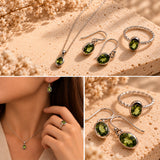
Selected by the material name used in the shop. This link does not identify an individual stone or confirm its treatment or origin.
Sources and locators
The numbers lead to the source records. Open an entry for the original source, its role and the relevant passage.
1 Reading the formula · Original research
2 Documented country examples · Original research
Gemological Characterization of Peridot from Pyaung-Gaung in Mogok, Myanmar (opens in a new tab)
3 Documented country examples · Original research
4 The material’s history · Collection record
5 The material’s history · Collection record
Peridot Pendant with Enamel Decoration, REF.2024-0089 (opens in a new tab)
6 Tradition and meaning · Current institutional classification
7 Wearing and care · GIA care guidance
8 Composition · Institutional reference
9 Composition · Institutional reference
10 Composition · Institutional reference
Additional references and detail
Measurements and sample series
In twelve San Carlos test stones, refractive index and density varied across the investigated colour range. Those measurements do not establish the origin of other stones. 3
The Pyaung Gaung series comprised five faceted stones and 28 pieces of rough, 33 samples in total. 2
The Roman Medusa ring stone is 1.8 centimetres long. The French pendant in Tokyo measures 8×4.5 centimetres. These dimensions belong to the respective museum objects. 4 5
Limits of this information
The examples concern the specimens, objects and sources named. They do not establish the origin, treatment or health effects of a specific item of jewellery.