

LEV MÉS · Materials
Pearl and baroque pearl
Pearls form in mollusks. Their grown shapes have inspired unusual jewellery designs, including a sea monster fashioned around a single baroque pearl. 1 3

Reading the formula
CaCO₃ 7
Calcium carbonate and organic matrix 7
CaCO₃ is the formula of calcium carbonate in a pearl: calcium, carbon and oxygen in a 1:1:3 ratio. There is also an organic matrix. The formula alone therefore does not describe a pearl’s entire structure. 7
Material classification is not an analysis of an item of jewellery offered for sale.
Formation and properties
Structure and character
Natural pearls, cultured pearls and shape
Natural pearls form without human intervention. In cultured pearls the process is initiated by humans. An irregular exterior does not determine which is present. 1
Layers beneath the surface
A smooth surface can conceal a complex architecture. Cross-sections of Akoya keshi pearls about three millimetres across revealed aragonite tablets ordered over medium distances. Their layers were neither random nor perfectly regular. The finding published in 2021 concerns the nacreous pearls examined. 2
Documented country examples
AustraliaResearch samples collected directly
Eighty Mile Beach, Western Australia 1
For their study published in 2021, GIA researchers collected natural pearls in 2013 from wild Pinctada maxima mollusks off Eighty Mile Beach, Western Australia. Their known origin made these samples particularly valuable for laboratory research. This is a marine-pearl example, not an origin claim for all baroque pearls. 1
Country areas provide orientation. Records may concern occurrences, examined specimens or collection objects; each country states its role. No mine locations or confirmation of the origin of our jewellery.
The material’s history
Neptune and the origin in water
In Metropolitan Museum pendant 1982.60.378, a baroque pearl forms a sea monster’s body beneath Neptune. Enamelled gold, rubies, diamonds and other pearls complete the figure. The museum dates it to the early seventeenth century, probably Netherlandish, and connects its subject with the pearl’s shape and aquatic origin. 3
1890 4
Baroque pearl is not a date
A pendant dated around 1890 in Tokyo’s National Museum of Western Art is likewise titled Baroque Pearl Pendant. Record OA.2012-0488 lists freshwater pearl, diamond, gold and platinum. Here baroque describes pearl shape, rather than dating the jewel to the Baroque period. 4
The pearl’s shape becomes part of the story
For the Neptune pendant, the museum interprets the pearl’s shape and origin in water as part of the marine imagery. The meaning lies in the design of the jewel. This does not establish a health effect. 3
What this source establishes
For the Neptune pendant, the museum reads the shape of the pearl and its origin in water as part of the sea motif. This is an interpretation of the designed piece of jewellery, not a statement about any effect of the pearl.
Wearing and care
Everyday care
Wipe cultured pearls with a very soft clean cloth after wearing. GIA advises against ultrasound and steam. After occasional cleaning with warm soapy water, the string must also dry completely. 6
The complete piece
This recommendation concerns the named material. Jewellery also requires consideration of its setting, coating, string and other components.
From material to jewellery
Pearl and baroque pearl in jewellery
-
 Baroque Pearl Necklace with Emerald
-
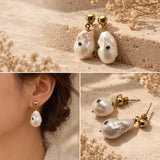 Baroque Pearl Earrings with Emerald
-
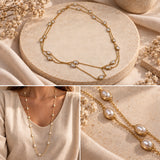 Pearl Necklace
-
 Fluorite Bracelet


Show 3 more pieces
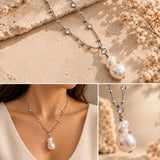


Selected by the material name used in the shop. This link does not identify an individual stone or confirm its treatment or origin.
Sources and locators
The numbers lead to the source records. Open an entry for the original source, its role and the relevant passage.
1 Structure and character · Original research
2 Structure and character · Original research
3 The material’s history · Collection record
Pendant in the Form of Neptune and a Sea Monster,1982.60.378 (opens in a new tab)
4 The material’s history · Collection record
5 A closer look · Original research
6 Wearing and care · GIA care guidance
7 Composition · Original research
Additional references and detail
What a pearl’s interior reveals
Examination of 774 natural pearls from wild Pinctada maxima mollusks revealed internal structures also found in non-bead cultured pearls. 1
How an early date can be tested
In a 2017 study of 85 saltwater pearls offered as historical specimens, material analyses and radiocarbon dating supported the proposed early date. Their precise provenance nevertheless remained incompletely known. Age and provenance were separate questions, answered by more than appearance alone. 5
Your own pearl
A particular pearl’s formation, origin and possible treatment require individual documentation. Baroque pearl describes its shape in the first instance.
Limits of this information
The examples concern the specimens, objects and sources named. They do not establish the origin, treatment or health effects of a specific item of jewellery.