← All materials

LEV MÉS · Materials

Moonstone

Moonstone appears in jewellery as a shimmering feldspar material. The composition and treatment of an individual piece remain separate questions alongside its history and design. 4

Digital illustration for the Moonstone chapter.
Digital illustration. It provides orientation and does not establish material identity.
Material
Feldspars with a moving sheen 7 8 9
Formula
Material-dependent 7 8 9
Mohs hardness
6–6.5 10

Understanding the composition

Feldspars with a moving sheen 7 8 9

Orthoclase

Potassium feldspar 7 8 9

Albite

Sodium feldspar 7 8 9

Rainbow moonstone

Labradorite 7 8 9

Classic moonstone contains fine intergrowths of orthoclase and albite. Rainbow moonstone is a trade name for labradorite with an iridescent sheen. The name alone therefore does not define one uniform formula. 7 8 9

Material classification is not an analysis of an item of jewellery offered for sale.

Formation and properties

Distinguishing material from filler

A necklace examined in 2013 contained 22 moonstone beads. Analysis indicated a composition close to albite and confirmed added material in fissures. The case concerns that selected necklace, not treatment frequency in the trade or the condition of other pieces. 4

Documented country examples

Country examples from the cited sources
Occurrence or specimen example
Sri LankaFirst-hand field visit in 1981

Meetiyagoda 11

In September 1981, Mahinda Gunawardene visited the moonstone mine at Meetiyagoda on Sri Lanka’s southwest coast. His 1983 field report records first-hand observations in the mining area. It is a documented locality example, not evidence of the origin of an individual moonstone. 11

Country areas provide orientation. Records may concern occurrences, examined specimens or collection objects; each country states its role. No mine locations or confirmation of the origin of our jewellery.

Map base: Natural Earth · Public domain

A luminous centre in ancient gold

The Cleveland Museum dates a Greek necklace to the second century BCE. Its modern identification describes a translucent moonstone at the centre, framed by garnets and small pearls. The material forms part of a carefully arranged colour composition. 2

Love token and birth month

In 1913, Kunz described moonstone as a lovers’ gift. The 1912 list he reproduced places it beside pearl for June. 6

What this source establishes

Period attributions, not an efficacy test.

Wearing and care

  • Protect against impacts

    Moonstone has cleavage directions. A hard impact or sudden temperature change can damage it. 10

  • Clean gently

    GIA recommends warm, soapy water and advises against ultrasound and steam. 10

From material to jewellery

Moonstone in jewellery
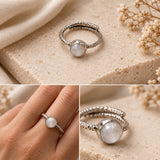
Selected by the material name used in the shop. This link does not identify an individual stone or confirm its treatment or origin.

Sources and locators

The numbers lead to the source records. Open an entry for the original source, its role and the relevant passage.

1 A closer look · Original research

On the perthitic structure of moonstones (II): High temperature form of moonstone (opens in a new tab)

Technical publication or laboratory report

Source reference: Mineralogical Journal 7(1), pp. 9–11: Abstract, Specimens, Experimental methods.

2 The material’s history · Collection record

Cleveland · necklace 1928.234 (opens in a new tab)

Collection or object record

Source reference: Object 1928.234: date 100s BCE; Description, central moonstone and surrounding settings.

3 A closer look · Collection record

Ring, 1944.73 (opens in a new tab)

Collection or object record

Source reference: Details: Date 1800s; Cambodia; Medium; Object number 1944.73; Description.

4 Structure and character · Original research

GIA · filled moonstone (opens in a new tab)

Technical publication or laboratory report

Source reference: Original Abstract; Materials and Methods: strand of 22 beads.

5 A closer look · Original research

Symmetry constraints during the development of anisotropic spinodal patterns (opens in a new tab)

Technical publication or laboratory report

Source reference: Abstract; Results/The iridescence phenomenon and Spinodal patterns; Methods/Samples preparation.

6 Tradition and meaning · Historical original text

Kunz · 1913 (opens in a new tab)

Historical textual record

Source reference: Moonstone, pp. 97–98; table, pp. 319–320.

7 Composition · Institutional reference

GIA · Moonstone Description (opens in a new tab)

Institutional reference

Source reference: Paragraphs on orthoclase/albite and rainbow moonstone.

8 Composition · Institutional reference

Handbook of Mineralogy · Orthoclase (opens in a new tab)

Institutional reference

Source reference: Single-page entry: formula heading and Chemistry.

9 Composition · Institutional reference

Handbook of Mineralogy · Albite (opens in a new tab)

Institutional reference

Source reference: Single-page entry: formula heading and Chemistry.

10 Wearing and care · GIA care guidance

GIA · Moonstone Care and Cleaning Guide (opens in a new tab)

GIA care guidance

Gemological Institute of America

Source reference: Hardness and toughness; Stability; Cleaning

11 Documented country examples · Source record

Pyrite and marcasite occurrence in Sri Lanka with special emphasis on Meetiyagoda gem field (opens in a new tab)

First-hand field report

Mahinda Gunawardene · 1983

Source reference: Journal of Gemmology 18(7), p. 635: September 1981 visit; pp. 638–639: mining observations

Limits of this information

The examples concern the specimens, objects and sources named. They do not establish the origin, treatment or health effects of a specific item of jewellery.

← All materials