

LEV MÉS · Materials
Amethyst
Amethyst is purple quartz. At Los Catalanes, its crystals line large cavities in volcanic rock. As a jewellery stone, it was carved into miniature images in antiquity. 7 10 3

Reading the formula
SiO₂ 11
Quartz
Material classification is not an analysis of an item of jewellery offered for sale.
Formation and properties
Structure and character
What makes it purple
The purple colour is linked to iron within quartz. Heating changed the colour of examined natural amethyst samples: they became colourless or yellow. Colour and possible treatment therefore belong in a description of the stone. 1
The cavity and its filling
The crystals at Los Catalanes did not form at the same time as the molten lava. An isotope study places mineral deposition in a later phase: after the eruptions, meteoric water interacted with the existing volcanic rock. 9
Documented country examples
Country areas provide orientation. Records may concern occurrences, examined specimens or collection objects; each country states its role. No mine locations or confirmation of the origin of our jewellery.
Small images from antiquity
A Greek ring stone in the Metropolitan Museum is only about 1.5 centimetres long. The catalogue dates it to the fourth century BCE and describes a griffin biting a deer’s neck. 3
A Roman amethyst in the same museum depicts Fortuna, or Tyche, with a cornucopia and rudder. It is dated approximately to the first–second centuries CE. The motifs belong to the worked objects, not to a demonstrated effect of the mineral. 4
Pliny and the claim about drunkenness
In Natural History 37.124, Pliny records a claim under the name amethysti that such stones could ward off drunkenness. He explicitly dismisses it as an empty promise of the magicians. 6
What this source establishes
The ancient name is not a mineral identification of a present-day stone. The text documents a claim and its criticism.
Wearing and care
Everyday care
Amethyst has a Mohs hardness of 7. GIA recommends warm soapy water, no steam and no strong heat. Sudden temperature changes can cause fractures; prolonged intense light can fade some colours. The setting and other jewellery materials also require suitable care. 10
From material to jewellery
Amethyst in jewellery
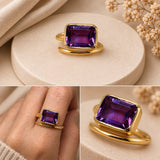


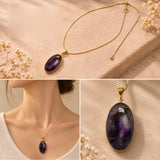
Selected by the material name used in the shop. This link does not identify an individual stone or confirm its treatment or origin.
Sources and locators
The numbers lead to the source records. Open an entry for the original source, its role and the relevant passage.
1 Structure and character · Original research
2 A closer look · Original research
Gem-Quality Amethyst from Rwanda: Optical and Microscopic Properties (opens in a new tab)
3 The material’s history · Collection record
4 The material’s history · Collection record
5 A closer look · Collection record
6 Tradition and meaning · Historical original text
7 A closer look · Institutional reference
Deposits of amethysts of Los Catalanes Gemological District (opens in a new tab)
8 A closer look · Source record
9 Structure and character · Original research
10 Wearing and care · GIA care guidance
11 Composition · Nomenclature
Limits of this information
The examples concern the specimens, objects and sources named. They do not establish the origin, treatment or health effects of a specific item of jewellery.